
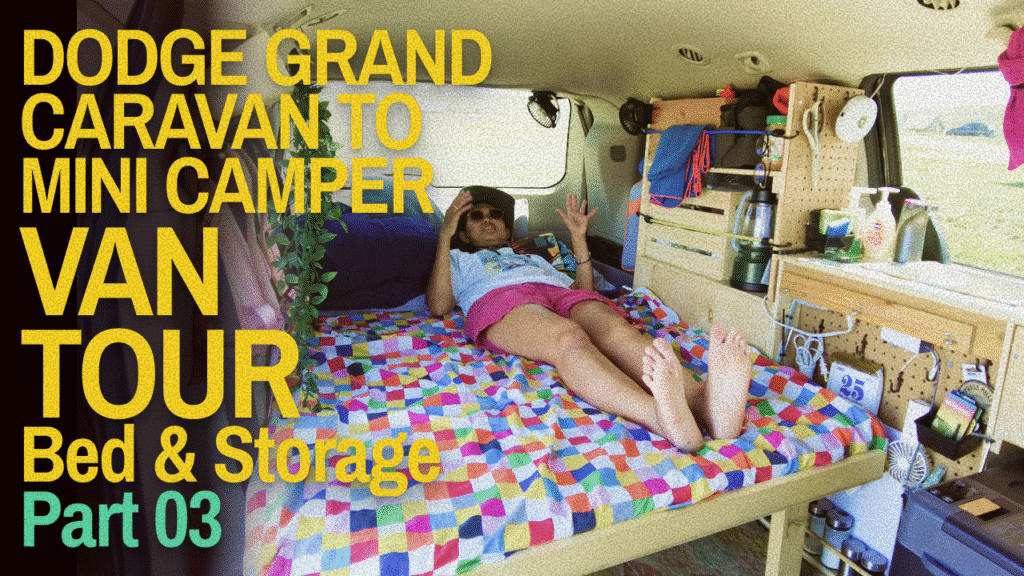
When we first started Camp My Minivan, we didn’t expect our little Dodge Grand Caravan, affectionately named Timmy, to take us more than 13,000 kilometers across Canada. What began as a weekend project to create a functional, cozy camper slowly turned into a full-on lifestyle experiment in tiny living.
After two months on the road, we’ve finally wrapped up our full van tour. This article brings together everything we’ve learned about building a practical, comfortable minivan camper, from solar setup and hidden storage to bed design and lighting that makes 6m² feel like home.
Solar Setup: Simple, Portable, and Realistic
Our power system was intentionally minimalist. We used flexible solar panels connected directly to a Bluetti battery, making it easy to charge while parked under the sun.
On paper, the panels could reach up to 180 watts per hour in perfect conditions. In reality, the performance was closer to 120–150 watts, even on bright, clear afternoons. It meant that a full recharge could take almost 10 hours of consistent sunligh, something that rarely happens during travel.
Still, for short trips or moderate use, this setup worked beautifully. It required almost no installation and gave us enough power to charge our essentials, run lights, and edit videos. For longer adventures or full-time vanlife, though, a rooftop solar system would be more reliable. That’s the direction we’re heading for our next build, after seeing firsthand how weather variability affects portable panels.
Hidden Back Storage: Compact, Clever, and Work-Friendly
One of the most satisfying parts of our build is the hidden storage compartment tucked behind the bed. It was born out of necessity, we both work remotely and needed space for a 27-inch monitor and later a Starlink box.
Both items fit perfectly into this slim section, easily accessible from the back of the van yet invisible when the doors are closed. It’s the kind of small design choice that makes a big difference when you’re living full-time on the road: discreet, functional, and multipurpose.
Using Every Inch: The Pegboard & Fans
Above the storage area, we noticed a space that couldn’t handle solid framing but was too valuable to leave empty. That’s where the pegboard came in, one of the most useful pieces of our entire van.
We used it to hang everyday essentials: camera gear, chargers, cooking tools, and two mini clip-on fans that quickly became lifesavers on hot nights. They run quietly on minimal power, attach anywhere, and even double as campfire helpers when airflow is needed.
It’s a good reminder that vanlife comfort often comes down to small, smart tools, not major installations.
Under-Bed and Side Storage: Choosing Flexibility Over Structure
When every cubic centimeter counts, flexibility beats perfection.
Under the bed, we left enough height for three large storage boxes, one each for clothing, kitchen supplies, and miscellaneous essentials. The boxes slide in and out easily, secured with hooks and bungee cords.
On the side, we built two lightweight layers of storage, also held in place with cords rather than heavy drawers. This allowed us to adjust what we packed along the journey, from food and snacks to gear and refilling water bags.
We even kept space for a Mac Mini, which connected to the monitor for work, editing, and the occasional Netflix night.
Lighting was another area where flexibility mattered. A ceiling LED strip runs softly around the van, bright enough to cook or read yet dim enough to stay discreet when parked overnight. A few portable LED lanterns provided extra light for board games or late-night walks.
These small, layered lighting solutions made the space feel warm, lived-in, and comfortable, proof that a good camper isn’t built from furniture, but from intention.
Bed Design: Comfort, Simplicity, and Adaptability
The bed design was easily the most asked-about feature of our build, and for good reason.
Inspired by Eric Enjoys Earth on YouTube, we adapted his convertible frame concept to fit our needs. The result was a sofa-to-bed system that could also preserve an extra seat when needed.
In total, the frame measures 140 cm with an extendable 30 cm panel, supported by detachable legs instead of bulky hinges. It’s strong, light, and flexible, everything you want in a small camper.
With this setup, the van can comfortably carry and sleep three people, which turned out to be surprisingly useful while visiting friends across Winnipeg, Toronto, Montreal, and PEI.
We also added a foldable bar to prevent the mattress from sliding in sofa mode, a simple touch that made daily use smoother. Whenever we needed to switch back to a normal car, the entire bed could be removed within minutes.
The key insight? Design around your lifestyle, not aesthetics. It’s better to have a build that works for your habits than one that only looks good in photos.
Lessons After 13,000 Kilometers
We filmed the final part of our tour at Grasslands National Park, Saskatchewan, just before ending our two-month cross-Canada trip. It was the perfect place to reflect on what worked, and what didn’t.
Here’s what we learned along the way:
- Flexibility matters more than rigid structure.
- Test everything on the road, not just at home.
- Comfort and usability always beat visual perfection.
Vanlife isn’t about escaping reality; it’s about redefining it. It’s learning to enjoy simplicity, to live slowly, and to make a home wherever you park.
What’s Next at Camp My Minivan
This marks the end of our Dodge Grand Caravan camper tour, but definitely not the end of our journey.
We’ll be sharing upcoming posts about:
- The real highs and lows of life on the road
- How to balance remote work and travel
- Practical tips for small-space living and future upgrades
If you’re dreaming of your own DIY minivan conversion or planning a road trip across Canada, we hope this story gives you a few ideas, and the confidence to start building.
From 90m² to 6m², this little home taught us that happiness doesn’t take space, it takes intention.